- Explaining the fundamental behavior of materials through the investigation of atomic structure, crystal lattice systems, and microstructure–property relationships.
- Establishing accurate material selection criteria for specific engineering applications by comparing metallic, ceramic, polymeric, and composite material groups.
- Analyzing the thermodynamic equilibrium of materials under operating conditions through phase diagrams and phase transformations
- Modeling material phases and equilibrium states in a computational environment using thermodynamic and kinetic simulation software.
- Predicting the effects of alloy composition variations on material properties prior to laboratory testing.
- Implementing optimization methodologies for manufacturing and heat treatment parameters to reduce R&D and trial production costs.
- Evaluating and interpreting fundamental mechanical test data—including tensile, compression, hardness, toughness, and fatigue tests—in accordance with international standards.
- Assessing elastic and plastic deformation mechanisms as well as the influence of dislocation motion on material strength.
- Calculating safety factors of components under service loads using stress–strain curves.
- Examining the operating principles and process parameters of forging, rolling, extrusion, and sheet metal forming operations.
- Determining die and press requirements by calculating yield criteria, deformation resistance, and friction factors.
- Mastering preventive engineering techniques against forming defects such as cracking, tearing, and springback.
- Acquiring practical proficiency in liquid metal flow, solidification kinetics, and shrinkage/feeder (riser) calculations.
- Comparing sand casting, investment casting, and die casting processes based on component geometry and alloy type.
- Identifying casting defects—such as gas porosity, slag inclusions, and cold shuts—and developing root-cause corrective solutions.
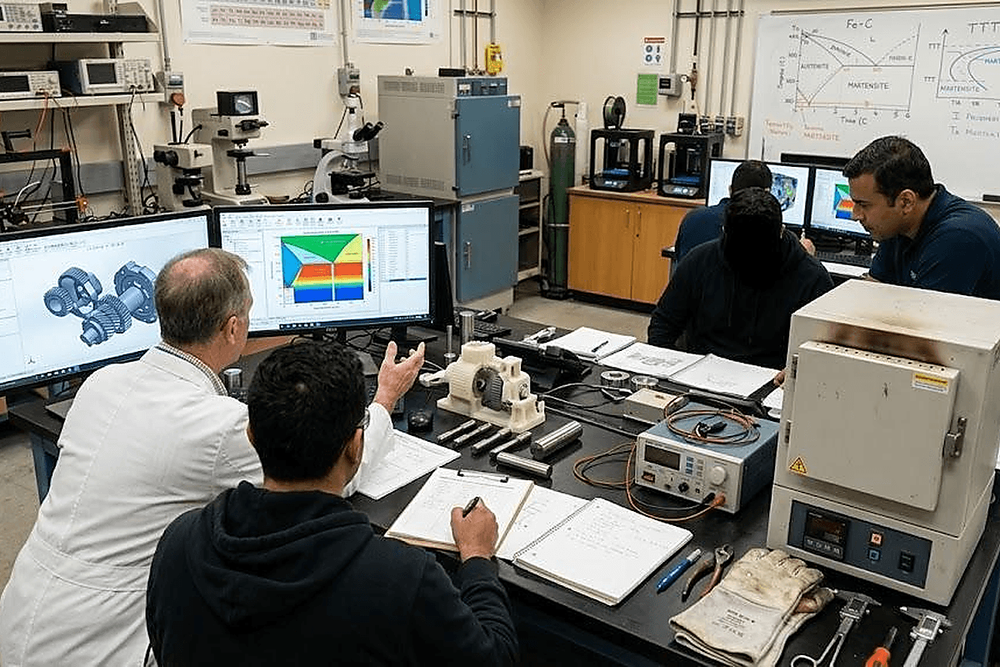
- Determining microstructural transformations as a function of cooling rates through the analysis of TTT (Time–Temperature–Transformation) and CCT (Continuous Cooling Transformation) diagrams.
- Designing process sequences for hardening, annealing, tempering, normalizing, and thermochemical surface hardening (carburizing and nitriding).
- Managing heat treatment furnace parameters, protective atmospheres, and the risks of distortion and residual stress.
- Understanding classification standards for carbon steels, low-alloy steels, tool steels, and stainless steels.
- Analyzing the effects of alloying elements (such as Cr, Ni, Mo, and V) on hardenability, corrosion resistance, and toughness.
- Selecting optimal steel grades compliant with technical specifications for critical components in the automotive, machinery, and construction industries.
- Comprehending the mechanical and physical characteristics of wrought and cast aluminum series ranging from 1xxx to 7xxx.
- Determining the mechanisms and temperature–time parameters of precipitation hardening (artificial and natural aging, such as T4 and T6 tempers).
- Selecting optimized alloys for engineering designs requiring superior corrosion resistance, anodizing compatibility, and lightweighting.
- Investigating the electrical, thermal, and mechanical advantages of brasses, bronzes, and high-conductivity copper alloys.
- Selecting appropriate alloy grades for bearing, gear, and marine applications demanding high wear resistance and corrosion durability.
- Evaluating the effects of cold working and annealing processes on the formability of copper alloys.
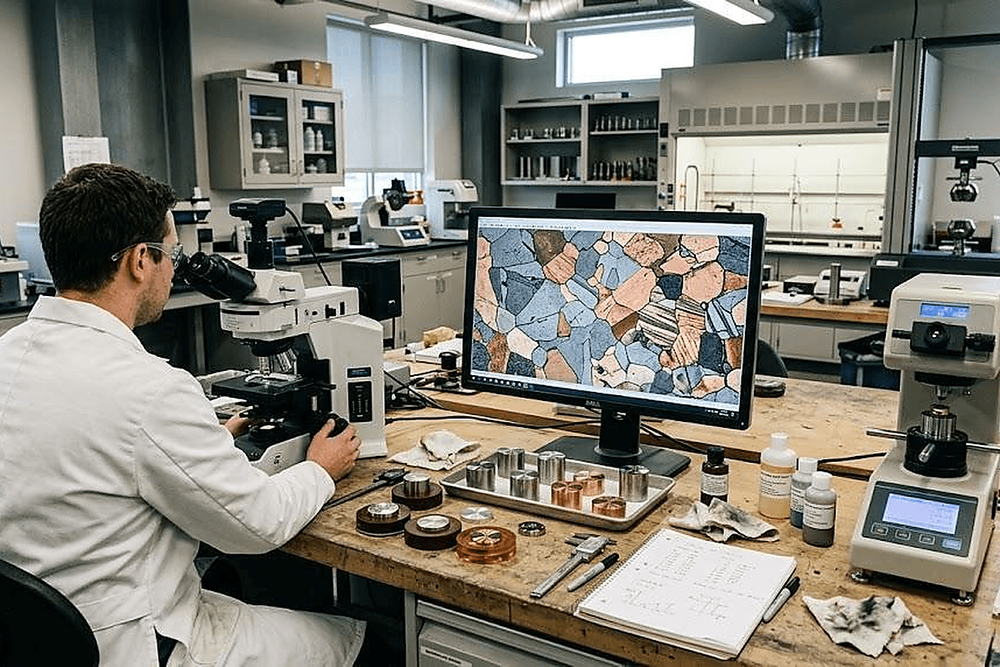
- Executing specimen sectioning, mounting, grinding, polishing, and chemical etching procedures in compliance with international standards.
- Characterizing phases, grain size, non-metallic inclusions, and segregation phenomena using optical microscopy and scanning electron microscopy (SEM).
- Preparing comprehensive quality control reports by interpreting microstructural micrographs through quantitative image analysis techniques.
- Mastering the engineering dynamics of transitioning laboratory-scale bioprocesses to pilot- and industrial-scale bioreactor capacities.
- Modeling agitation, aeration, and shear stress parameters that evolve with increasing vessel volume.
- Establishing process control and regulatory compliance strategies to prevent yield loss during scale-up operations.
- Selecting appropriate batch, fed-batch, or continuous bioreactor configurations to match operational process goals.
- Specifying impeller geometry, sparger arrangements, heat transfer components, and analytical sensor instrumentation.
- Enforcing clean-in-place (CIP), sterilization-in-place (SIP), and aseptic barrier standards for cross-contamination control.
- Determining and optimizing volumetric mass transfer coefficients for dissolved oxygen in gas–liquid systems.
- Assessing the impact of power input per unit volume, Reynolds numbers, and fluid flow regimes on cellular viability.
- Simulating multi-phase fluid dynamics to pinpoint process bottlenecks, shear gradients, and dead zones.
- Designing sequential recovery steps utilizing centrifugation, depth filtration, tangential flow filtration, and preparative chromatography.
- Preserving structural stability and functional activity of sensitive biomolecules while maintaining elevated purification yields.
- Developing cost-efficient downstream processing trains that lower buffer consumption and streamline waste management.
- Comparing technical performance between open raceway ponds and enclosed photobioreactor systems for microalgae cultivation.
- Optimizing light distribution, temperature, pH, and nutrient feeding strategies to maximize biomass accumulation.
- Managing industrial downstream operations including harvesting, dewatering, cell disruption, and target molecule extraction.
- Investigating microbial fermentation routes and synthesis protocols for bio-based polymers (e.g., PLA, PHAs).
- Applying industrial isolation, harvesting, and purification techniques to recover polymer streams at high purity.
- Evaluating thermal and mechanical behavior of bioplastics using analytical tools such as DSC, TGA, and tensile testing.
- Translating biological architectures, lightweight functional patterns, and structural hierarchies into engineering solutions.
- Developing biomimetic product concepts focused on functional surfaces, drag reduction, lightweighting, and compliance.
- Integrating advanced manufacturing processes, such as additive manufacturing, to realize nature-inspired geometries.
- Calculating organizational and product carbon footprints according to Greenhouse Gas (GHG) Protocol methodologies.
- Developing transition roadmaps compliant with corporate ESG reporting frameworks and international green taxonomy criteria.
- Identifying energy efficiency opportunities and circular resource flows to reduce environmental impact across operations.
- Integrating Cradle-to-Cradle circularity models into conventional production frameworks and supply chains.
- Developing industrial symbiosis initiatives where by-products and operational waste serve as secondary feedstocks.
- Building bio-based economic models that decouple manufacturing from fossil-based materials and non-renewable resources.
- Reading balance sheets, income statements, and cash flow reports to evaluate corporate financial stability or personal finances.
- Applying core economic principles including compound interest, time value of money, and inflation to financial decision-making.
- Implementing structured cash flow forecasting, debt optimization, and liquidity risk mitigation techniques.
- Acquiring foundational knowledge of capital market regulations, legal frameworks, and professional ethical standards.
- Reviewing licensing examination modules, case studies, and compliance obligations for regulated financial markets.
- Mastering the operational structures of brokerage firms, portfolio management companies, and collective investment funds.
- Conducting company valuations using key valuation multiples (P/E, P/B, EV/EBITDA) and macroeconomic indicators.
- Interpreting price action, trend structures, support/resistance levels, and technical indicators (RSI, MACD, Moving Averages).
- Formulating risk-managed trading strategies with defined trade entry criteria, profit targets, and stop-loss rules.
- Constructing asset allocation models tailored to specific investor risk-return profiles across equities, fixed income, and commodities.
- Applying Modern Portfolio Theory principles and strategic diversification to control portfolio volatility.
- Designing disciplined portfolio rebalancing strategies to adapt to shifting macro market cycles.
- Optimizing working capital management, cash conversion cycles, and operational liquidity buffers.
- Evaluating capital investment decisions and capital budgeting feasibility via Net Present Value (NPV) and Internal Rate of Return (IRR).
- Calculating the Weighted Average Cost of Capital (WACC) to establish an optimal capital structure of debt and equity.